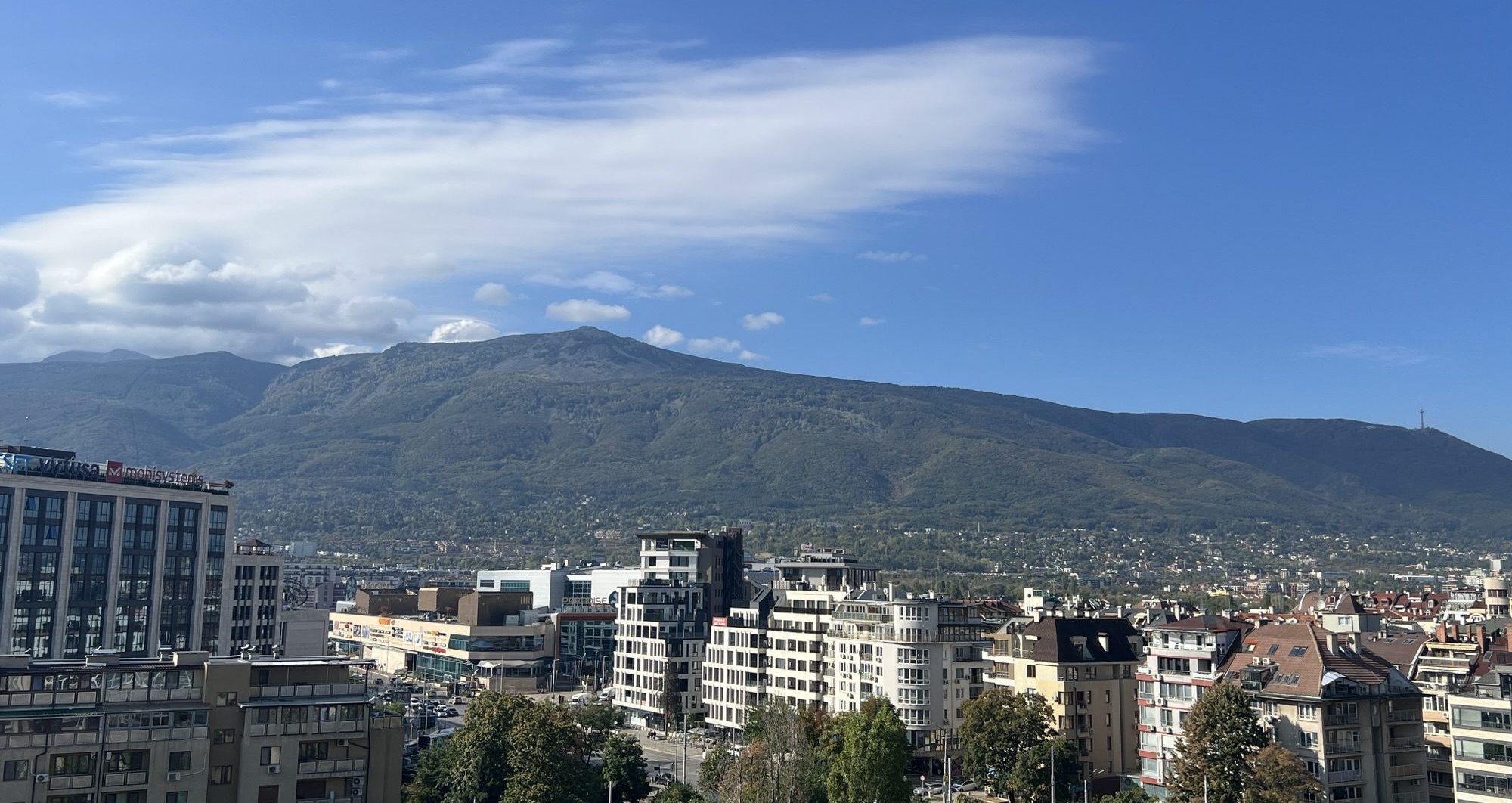
Big goals look close from a distance. But you never see the trail. That’s why most people stay stuck: not because they lack options, but because they’re staring at the summit (and often comparing their path to everyone else’s). Here’s the simple method I use with my coaching clients to take action again when a goal feels too big, and it takes one week to try.
In short: find your next marker
- What’s one step I can take in the next 7 days?
- What would that step teach me?
- What’s the smallest version of it?
The summit problem
I’m writing this from Sofia, with a view of Vitosha, the mountain at the edge of the city. From my desk it looks almost walkable. But from down here you can’t see a single trail. Just one big shape and a vague feeling of “someday.”
A career change, a new leadership role, a business you want to build: they look exactly like that. You see the end state clearly. You don’t see the way. So you keep looking at the summit, and you stay at your desk.
On the trail, nobody looks at the summit
Once you’re actually on Vitosha, the summit disappears behind the trees. You don’t need it anymore. You follow the next painted marker on a tree, then the next. Nobody on that trail thinks about the whole mountain. They think about the next fifty metres, and that’s exactly why they reach the top.
In coaching, I see the opposite. People try to answer every summit question at once: Is this the right industry? What if it doesn’t pay? What if I fail in year three? You can’t answer those from the bottom. Trying to is what keeps you there.
How to take action: the next-marker method in 3 questions
The next-marker method is a simple way to beat analysis paralysis: instead of planning the whole route to a big goal, you only define the next small step you can reach within a week, take it, and let what you learn shape the step after that. Three questions get you there:
- What’s one step I can take in the next 7 days? Not “change careers.” More like “have coffee with one person who does the job I’m curious about.”
- What would that step teach me? Every marker is information. You don’t just move, you find out whether this direction still feels right, and whether it fits who you actually are.
- What’s the smallest version of it? If the step feels heavy, cut it in half. A small step you take beats a big step you plan.
None of these questions asks you to know where you’ll end up. That’s the point: clarity rarely comes before action. It comes from it.
What it looks like in real life
A typical example from my coaching: a client wanted to move from consulting into UX design. Her instinct was to research bootcamps for weeks and plan the whole switch. Her actual first marker was one coffee with a UX designer. We worked on who to reach out to and how to ask, so it felt like a real conversation, not begging for a job. That coffee led to two more introductions. Suddenly the trail had markers.
Where I am right now
I’m applying the same method myself. I’ve left Berlin and I’m travelling as a nomad for a while: Sofia now, Barcelona next, and back in Berlin in November, giving a compact coaching course in German. Here in Sofia I’m building something for yoga studios with a partner: we help studios run and grow their business. Our next marker? Talking to studio owners. Run one? Write me.
For you, nothing changes: I’m fully available online, anytime.
Your next marker
What’s your mountain right now? If it’s your career, my free live webinar From Stuck to Flow is built around exactly this: finding your next step, in 60 minutes, online.
Prefer to talk it through 1:1? Book a free 30-minute call.
Greetings from the foot of Vitosha,
Niv
FAQ: taking action on big goals
What is the next-marker method?
The next-marker method is a way to take action on a big goal without planning the whole route. You define only the next small step you can reach within seven days, take it, and use what you learn to choose the step after that.
What is analysis paralysis?
Analysis paralysis is the state of overthinking a decision so much that you never act on it. It usually happens when you try to answer every long-term question, like salary, industry or long-term risk, before taking a single step.
How do I take the first step in a career change?
Start with a step that gives you information, not a final decision. For example, have one conversation with someone who does the job you are curious about. Ask what their day looks like and what they would do differently. One conversation often leads to the next.
What if my goal still feels too big?
Make the step smaller. If “change careers” feels impossible, “update my LinkedIn headline” or “send one message this week” might not. A small step you actually take beats a big step you only plan.
Get the next story in your inbox
This story is part of my monthly newsletter: one personal story, practical tools on career change and leadership, and updates on what I’m working on. Subscribers also get offers you won’t find anywhere else, like a 90-minute 1:1 session at a subscriber-only price. No spam, unsubscribe anytime.



 English
  German