Career Change · Coaching · Berlin
Why “Which job is right for me?” is the wrong starting question — and the three-space model that puts career decisions in the right order.
“Which job is right for me?”
I hear this question almost every day. It sounds reasonable. It feels productive. And it quietly sends people in the wrong direction.
Because most people ask it before they’ve understood their actual problem. It’s already a solution question — but a solution to which problem?
I’m Niv Nicolas Nowbakht, a business and career coach in Berlin — and I didn’t learn this lesson from a textbook. I learned it at my own desk. More on that in a moment.
Key Takeaways in 30 Seconds
- “Which job is right for me?” is a solution question — most people ask it before understanding their actual problem
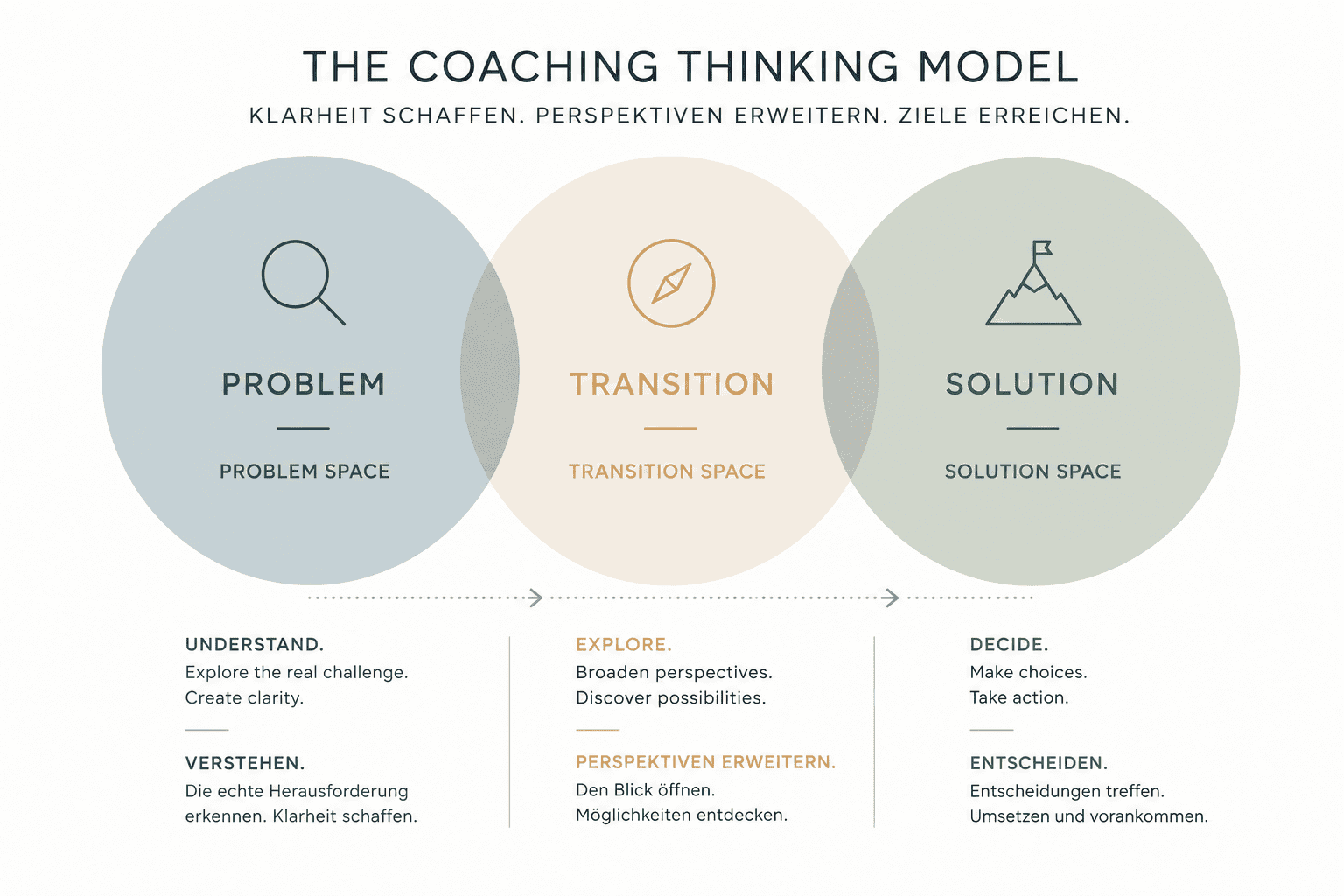
- Three spaces, one order: Problem Space (what’s wrong) → Transition Space (what’s possible) → Solution Space (what to do)
- The employer often isn’t the problem — an unresolved problem travels with you into the next job
- “I don’t know” said out loud is a starting point, not a failure — I learned that the hard way while leading a team
- Free 30-minute Clarity Call: a structured first look at your Problem Space, nothing to prepare
The Most Common Trap in Career Change
Here’s what a typical career change attempt looks like: You feel stuck. You open LinkedIn. You scroll job boards for weeks. You send out a few applications. Maybe you even land interviews.
And somewhere in the middle of it, a quiet suspicion grows: None of these jobs actually feel right. But I can’t say why.
That’s not a motivation problem. That’s a sequencing problem. You’re looking for solutions to a problem you haven’t defined yet.
In coaching, I work with three distinct spaces. In plain language: first understand what’s actually going on (the Problem Space) — then explore what’s possible (the Transition Space) — then decide and act (the Solution Space). Most people jump straight into the third space. The real work happens in the first.
The Problem Space: Why You Want to Leave Matters More Than Where You Go
This is where real career coaching starts. Not with:
- Which position should I apply for?
- What does my CV need?
- Which certification will move me forward?
But with questions like:
- What is actually making you want to change?
- When did you first notice something no longer fits?
- What is the current situation costing you, honestly?
- What do you never want to experience again?
- Which of your needs are going unmet right now?
And if that list feels like a lot right now: you don’t have to answer all five. One of them, thought through honestly, is enough for this week.
Something surprising happens here, again and again: the employer often turns out not to be the problem.
Maybe development has stalled. Maybe recognition is missing. Maybe the leadership above you doesn’t work. Maybe the company culture never fit. Maybe the role has simply become too small for who you’ve become.
The real problem usually runs deeper than the current job description. And if you don’t find it, you’ll carry it straight into the next job.
I Know This Trap From the Inside
There was a phase in my career when I was no longer working alone as a coach. I was leading a small team. Every Monday, I structured the week: what needs to get done, who takes what, where we’re headed. Suddenly I got to apply my own models up close — no longer just with clients, but on myself, in real leadership responsibility.
And that’s exactly where I walked into the trap I now warn others about. In my own coaching, it became clear: I often didn’t know which space I was actually in. I was making Solution Space decisions while the real problem was still not understood. I was stuck.
And being stuck with a team is doubly expensive. Being stuck alone is bad enough. But I was also burning other people’s time and energy — every week without clarity counted twice.
The thing that kept me blocked wasn’t the not-knowing itself. It was my shame about it. I thought that as a leader and a coach, I was supposed to have the answer. So I performed confidence instead of naming the problem — and that’s exactly what kept the team blocked.
“I don’t know the solution.” That sentence wasn’t a breakdown. It was the first honest look into my Problem Space.
The turning point came when I managed to let go of that emotionally. I went in head-on with a sentence I had been ashamed of before: “I don’t know the solution.” That wasn’t a breakdown. That was the first honest look into my Problem Space — and the moment the team could work again, because it was finally clear where we actually stood.
So I don’t teach this model because it sounds good. I was coached with it myself, and it changed how I work and how I lead.
And if you’re thinking “I don’t lead a team, that’s not my situation”: the mechanism is the same. Not knowing which space you’re in happens to the leader in the Monday meeting just as much as it happens to you, alone in front of a job board tab at 11 pm. Only the costs look different.
The Transition Space: Where Orientation Emerges
Only when the problem is clear does the space of possibilities open up. Now the questions change:
- Which strengths do you want to use more often?
- Which tasks give you energy instead of draining it?
- Which of your skills are transferable to other fields?
- What kind of work environment do you actually need?
- What small experiments could help you test new options before committing?
For me, by the way, the first experiment was tiny: not knowing the solution out loud, once. Only after that could I see which options were actually on the table.
This is where orientation emerges. Not by accident, not by scrolling, but through structured reflection. Many of my clients describe this phase as the moment the fog lifts: suddenly there are criteria instead of vague discomfort.
If you recognize yourself in that fog, this is exactly what I work on with people who are feeling stuck in their career.
The Solution Space: Decisions and Action
Only now do concrete steps make sense:
- Sharpening your positioning
- Optimizing your LinkedIn profile
- Networking with intention instead of obligation
- Building an application strategy
- Having real conversations
- Choosing the right further training
Notice the order. The solution comes at the end, not the beginning. Everything on this list becomes dramatically easier once you know what problem you’re actually solving. A LinkedIn profile written from clarity reads completely differently than one written from panic. Just like a Monday meeting led from clarity.
What I Took Away From This
The more time we invest in understanding the right problem, the clearer the next steps become. Almost automatically.
A career change is rarely just a job change. It’s usually a decision about how you want to work, what impact you want to have, and what kind of life you want to lead. Those are big questions. They deserve more than a job board search bar.
After 12+ years of career coaching in Berlin and across the DACH region, in German and English, grounded in ICF Certified Coaching Education and an M.A. in Communication Sciences, I can say this: the most valuable skill in a career transition isn’t decisiveness. It’s the willingness to look at the problem honestly before you solve it.
Three Questions to Take With You
If you’re considering a change right now, start here:
Not “I’m unhappy,” but: what exactly is missing or hurting?
If the answer is “nothing could make me stay,” that’s information. If there’s a list, that’s information too.
This question usually points directly at the Problem Space.
Good Solutions Come From Well-Understood Problems
If you’re currently asking “Which job is right for me?”, try replacing it for a while with “Why do I want something to change?” It’s a less comfortable question. It’s also the one that actually moves you forward.
And here’s the honest truth I had to learn myself: nobody maps their own Problem Space cleanly alone. We’re too close to it. I certainly was — with all my models in my back pocket.
That’s exactly what a first conversation is for. In a free 30-minute Clarity Call, we take a first structured look at your situation together — the same way I work with leaders in business coaching in Berlin. You don’t need to prepare anything, and you don’t need to know anything yet. “I don’t know” is the best starting point there is. I speak from experience.
A structured first look at your Problem Space — no pitch, no pressure, nothing to prepare.
Niv Nicolas Nowbakht is a business and career coach based in Berlin, working with career changers and leaders across the DACH region. 12+ years of coaching experience, grounded in ICF Certified Coaching Education, M.A. in Communication Sciences. He is also co-founder of an early-stage startup building AI tools for coaches.

Niv Nicolas Nowbakht
ICF-educated Career & Leadership Coach, Berlin · 12 years of experience · M.A. Communication Sciences



 English
  German